

Dispatch Game Review: Is It Worth Your Time?



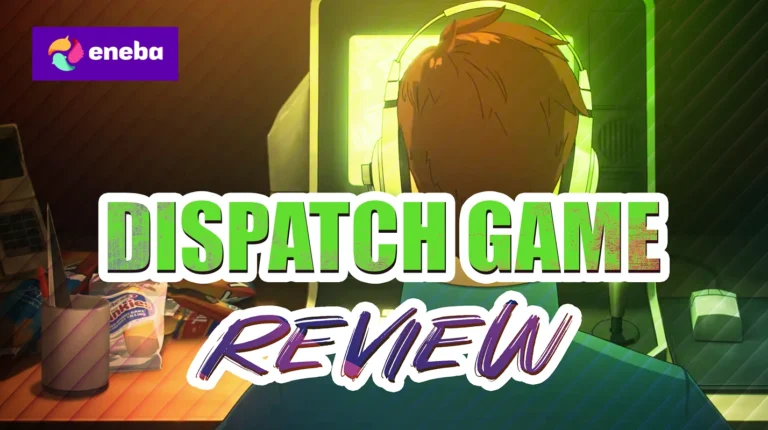
Dispatch is an interactive narrative superhero game that’s the debut title from AdHoc Studio, a new company comprised of former Telltale (Tales from the Borderlands, The Wolf Among Us) devs. It launched on PC, PS5, and Xbox Series X/S on Oct. 22, 2025, and was released in a format of two “episodes” per week.
I’ve played all eight to give you a spoiler-free Dispatch game review; I’ll dive into the story, how choices matter (or don’t), as well as the actual gameplay.
While it has its faults, the good news is that even for gamers with superhero fatigue, Dispatch offers a solid mix of action, comedy, and unexpected emotional beats. Up, up, and away!
Jump to:
Not Another Origin Story
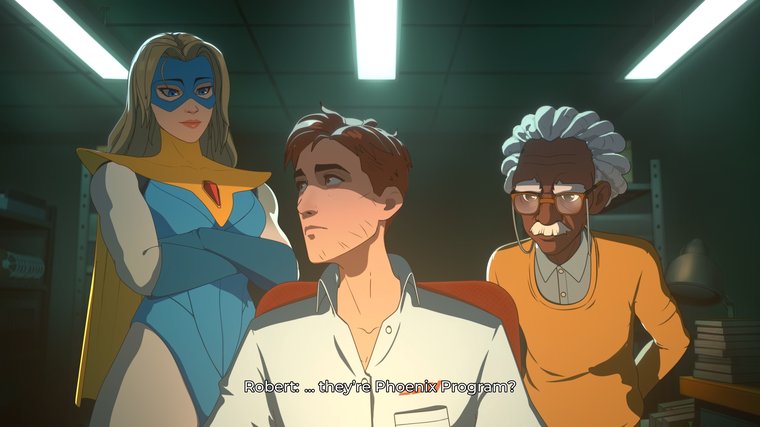
I’ll start my Dispatch game review by covering the basics. You take on the role of Robert Robertson the Third, who pilots a mech suit to protect Los Angeles as Mecha Man. After the suit is destroyed, Robert ends up being offered a job at the Superhero Dispatch Network (SDN), where he’s tasked with knocking a group of former supervillains into shape.
Dispatch is billed as a superhero workplace comedy, but that’s not quite right. While the game comes roaring out of the gate with two very strong episodes that mix superhero action with genuinely funny comedy, anyone expecting the quirkiness of something like The Office will be disappointed.
Instead, Dispatch favors a tone closer to the original live action version of The Tick (2001), which saw the superhero and his chums mostly hangout and banter.
The good news is that the majority of the humor is grounded in character and – aside from a few glaring pop culture references in episode three and a few too many fart jokes later on – rarely misses the mark.
Plus, as the game progresses it starts to show its true, contemporary, influence – Invincible. Dispatch is earnest and respectful of the superhero genre, but it’s smart enough to know when to get meta, and when to go HAM on powered beatdowns.
Please Hold, All Heroes Are Busy
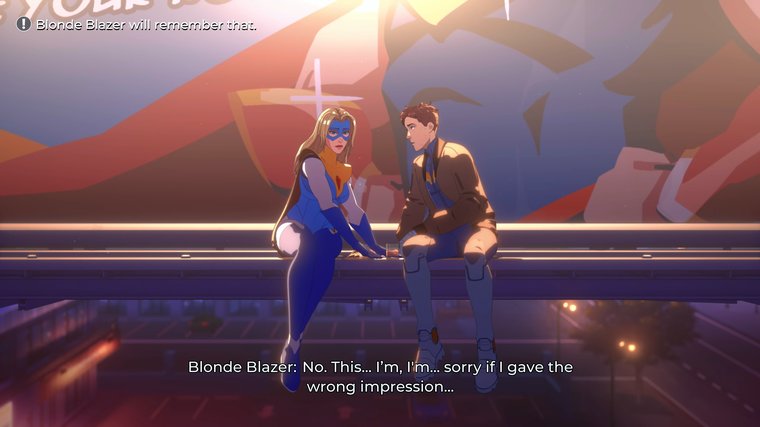
Anyone who’s played a Telltale game will know that these are the best games like Dispatch because they, broadly, include the same things: conversation choices on a regular basis, options as to what actions to take in a scene, and plenty of “[Character Name] will remember that” pop-ups.
However, where Telltale had to play around in someone else’s sandbox regarding IP, AdHoc created their own world for Dispatch, and this means that they’re free to cut loose a lot more.
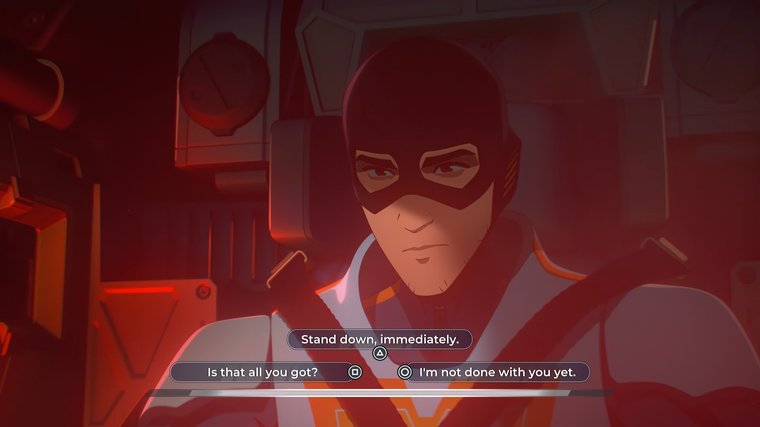
QTEs can be turned off for a more “Cinematic” experience, otherwise they mainly appear in fight scenes, such as a battle in episode one (titled “Pivot”) between Mecha Man and goons working for his nemesis, Shroud. Battles are very spaced out, though, and it’s not possible to “fail” a fight; QTEs simply help you feel a bit more invested and contribute towards end stats (these compare your playthrough choices to those made by other players).
The SDN is trying out a Phoenix Program, in which villains get a chance to reform through performing various heroic feats for the city. These can range from fighting terrorists gangs through to helping old ladies cross the road (no, really).
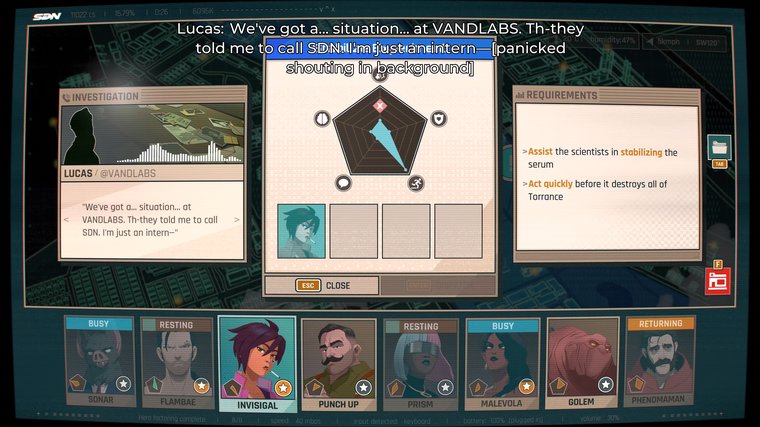
As Robert, it’s your job to manage them when they’re out in the field, and you do this by selecting would-be heroes from your “Z-Team” according to their personal stats. These are shown on a graph and reflect Combat, Vigor, Mobility, Charisma, and Intellect, with some characters better suited to certain situations than others.
Every so often, a job will also offer choices as to how to proceed, and sometimes an option will only be available if you have a specific hero on the call. Failures can result in injuries or a hero being downed, so you’ll have to wait longer to use them again.
On top of this, Robert will sometimes get the opportunity to hack into things, like security cameras and, early on, a bidet for some reason. While some gamers have asked AdHoc if an Endless mode of the dispatch section would be possible, I can see it overstaying its welcome very quickly if they ever change their mind about this.
AdHoc holds off on any exciting tweaks to the call and hacking mechanics until later in the game. It’s not until episode eight that calls directly affect the narrative, as they take the form of what amounts to a multi-stage boss fight.
Hacking doesn’t offer many surprises or true narrative cohesion until later, either, as Robert starts to hack elements of the environment to help an outnumbered hero and search for missing team members.
It’s also in the dispatch sections that the game most feels like one. Robert gets to level up at the end of a shift if he’s pulled off enough successful calls, which unlocks perks like being able to heal a hero. Z-Team members can themselves earn XP from successful tasks which you then assign to one of the core attributes.
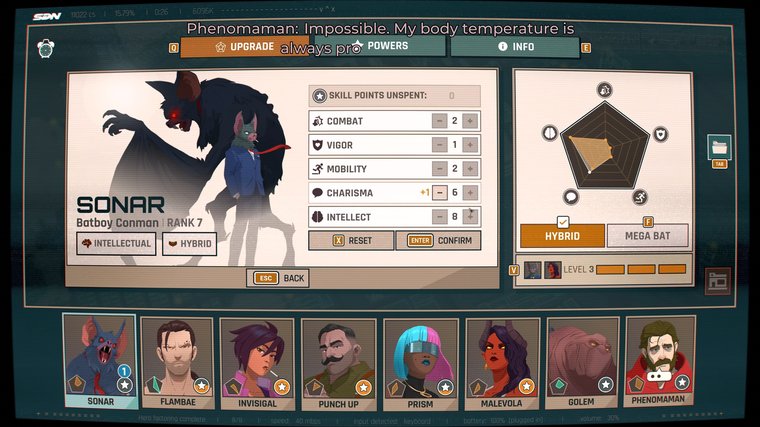
But, this never feels cohesive in the same way as if, for example, XP was couched in “coaching session” language and took a hero out of action for a little while. It’s even more glaring as the game actually does this later on, with characters disappearing for “training” with Robert’s boss, and potential love interest, Blonde Blazer.
Luckily, Dispatch papers over these quirks with a compelling story that rewards player agency…more or less.
Invisigal Will Remember That
Blazer and Z-Team member Invisigal are two ladies Robert effectively has to choose between at various points, with episode four making this explicit in a final choice. These kinds of choices are often genuinely difficult to choose between as, more often than not, someone will get hurt (emotionally, physically, or even both) by the outcome.
Robert also always has three options during dialogue, and to the game’s credit, they rarely feel like binary good/bad/jerk choices. These make it possible to roleplay Robert as a normal guy who’s trying his best, a disgruntled hero taking his frustrations out on his team, or a mix of both. You can also choose to not select anything and see which path the game takes by default.
While some dialogue and action choices have clear and immediate pay-offs, such as a chance mid-way through to reveal that Robert is Mecha Man, these are occasionally undermined by inconsistent earlier writing or outcomes that, to be blunt, feel disproportionate.
For the former, it seems that more people know who Robert really is than the game wants to acknowledge, and for the latter, several end-game resolutions didn’t stack up with Robert’s actions.
The most glaring of these followed me being as nice as possible to a particular person whenever it felt right to do so, and yet I somehow neglected them and sent them down a path of villany. Some of these can be chalked up to the overall nature of narrative choice games having a ton of branches to follow, but it is disappointing to see in a game from experienced devs.
A Natural 20
Thank goodness, then, that the overall quality is superb. Dispatch is one of the best story games I’ve ever played.
And here’s why: the writing is led by AdHoc co-founder Pierre Shorette, and his experience shows in fantastic character work, as well as several surprisingly emotional moments that tie into underlying questions of why heroes do what they do (“because helping people is the right thing to do” is one possible answer).
Special shout-out to Robert’s old-before-his-time super buddy, Chase, who gets some of the best scenes.
Dispatch started life as an animated series, and it shows. Expect lengthy stretches where all you as a player have to do is sit back and enjoy the action, voiced by a stellar cast that includes Aaron Paul (Breaking Bad) as Robert and Matthew Mercer as Shroud.
Matthew Mercer has extensive experience doing voice work for video games, including Fallout 4 and Marvel Cosmic Invasion, but he’s perhaps better known for being the DM with Critical Role.
This latter company is known for its Dungeons And Dragons campaigns, which have since spun-off into animated series and other media. The latest series, The Mighty Nein, appeared on Prime Video in November, 2025. Critical Role also helped fund the development of Dispatch, as well as shared other voice actors and set up a future AdHoc game.
As for Dispatch, episode eight (titled “Synergy”) ties up various plot threads involving Robert’s family tradition as Mecha Man, Shroud’s interesting belief that “evil can’t be stopped, only controlled,” and SDN’s promise to help Robert rebuild his suit if he helps the Z-Team.
AdHoc has recently said that it’s seriously considering making a season two of Dispatch, but even if they don’t, these eight episodes can easily stand as some of the best interactive fiction around, even if the actual game elements feel slight.
Heroes and Villains: Good and Bad Points
I promised no spoilers in this Dispatch game review, and I’ve kept to that, but I did miss the chance to talk about episodes as they dropped, as was AdHoc’s intent. I was also dying to share some real twists and turns, most of which manage to feel natural.
Each episode lasts around two hours at most, and the pacing varies. Dispatch has a very strong start and finish, but the middle sags as interpersonal dilemmas override the background narrative (some characters disappear for long stretches as major plot points slowly come into play).

Some reveals and outcomes don’t hold up to scrutiny nor seem to make sense given previous actions, but when they do they hit hard. Episode seven (“Retrospective”) in particular has a solemn tone that feels like a breath of fresh air despite its sombreness, and overall the narrative neatly sidesteps genre conventions by using them to fuel further twists.
The music and sound design are excellent throughout, with the option to remove licensed music (meaning streamers can play Dispatch and not get hit with copyright notices). Other accessibility options include a color blind mode and the ability to censor bad language and nudity.
My Overall Verdict: Style and Substance Help Dispatch Soar
The essence of my Dispatch game review is that it often feels like a 7/10 game pretending to be a 9/10, and if it was focused on the resource management and hacking sections, it would fail to grab me as much as it did. Luckily, these don’t make up the majority of the game, meaning that Dispatch lands closer to the high end of what it’s trying to achieve.
If you’re still thinking twice about suiting up for yet another slice of superhero media, I can promise that playing Dispatch is time well spent. I played it on PC, which felt like a natural fit, but it’ll also on Nintendo Switch and Switch 2 from Jan 28, 2026, which makes it easier to play/watch with someone else, like the best genre TV.
| Pros | Cons |
|---|---|
| ✅ Fantastic story ✅ Compelling characters ✅ Thought-provoking moral choices ✅ Very high quality animation ✅ Genuinely funny | ❌ QTEs often feel like an afterthought ❌ Hacking minigame takes too long to get interesting ❌ Some outcomes don’t feel like they match player choice |
Great for: Fans of resource management, choose-your-own-adventure, or anyone looking for one of the best superhero games around.
Less ideal for: Gamers who prefer a more-hands on experience, or anyone who hates quality writing.