

15 Most Expensive Pokémon Cards in 2026



There are a lot of factors to consider when discussing the most expensive Pokémon cards in 2026. Rare cards will, of course, be more expensive, but that’s hardly the only consideration.
Other elements include physical scarcity, competitive viability, nostalgia, sentimental value, and cultural impact; put all these together, and you’ve got a recipe for gold.
While there aren’t many cards that command such a high price, a select few do. These cards, which have all been verifiably sold (anything is only worth as much as someone will pay for it), have each fetched their owners a great sum of money.
The title of “most expensive” means nothing if no one will buy the card!
In this list, we’ll go through some top sellers – their history, card art, the grading they were given by which body, and more – and who knows? You might find that you own one of these gems.
Jump to:
15 Most Expensive Pokémon Cards
This list may contain a few surprises – I know it did for me – when it comes to just how much people will pay for particular cards. Whether it’s an extremely rare trophy card, an old favorite (in many different forms), a prototype product, or a gem that literally required you to burn away all your free time to get it, these cards show just how much a humble piece of cardboard can be worth!
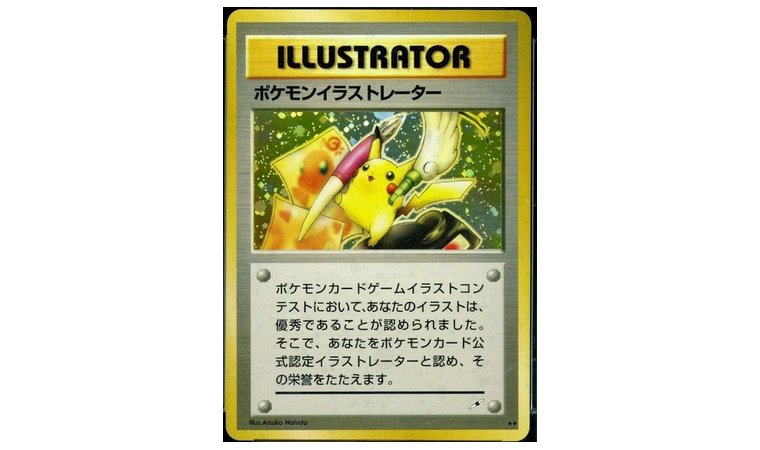
1. Pikachu Illustrator [PSA 10]
- Publication Date: 1998
- Grading: PSA 10
- Market Price: $16,500,000
Move over, Charizard – the crown of the most expensive Pokémon card ever now belongs to a PSA 10 Pikachu Illustrator. In February 2026, this very Pikachu Illustrator card made headlines again when Logan Paul sold it at auction for an astonishing $16.5 million, setting a new world record for the most expensive Pokémon card and the highest‑priced trading card ever sold at auction.
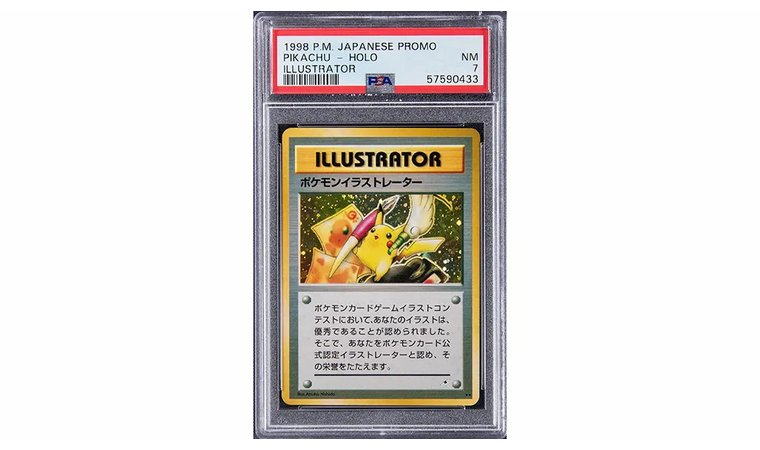
To figure out just why this card is so expensive, we’ll need to dig into its history. At first glance, it might not make any sense. Art-wise, it just has a cute, chubby Pikachu holding a paintbrush and a fountain pen, with drafts of a Charmander and something else to its right. This art was designed by Atsuko Nishida, one of the Pokémon franchise’s OG artists, and the card is (as expected) holofoil.
When it comes to Pikachu Illustrator’s effect, you can’t even play it. Its effect text, when translated to English (thanks, Bulbapedia), reads: “We certify that your illustration is an excellent entry in the Pokémon Card Game Illust Contest. Therefore, we state that you are an Officially Authorized Pokémon Card Illustrator and admire your skill.” Ah, there we are.
Officially, there are only 39 of these cards, though 2 more were never handed out, bringing the actual number to 41. The only way to get a Pikachu Illustrator was to be a winner of three illustration contests held by the Japanese company Corocoro Comic throughout 1997 and 1998.
What seals the deal on this Pikachu Illustrator is its PSA 10 rating. PSA – Professional Sports Authenticator – is an organization that uses clear metrics to rate trading cards. To hit a PSA 10, or Gem Mint grade, the card must be perfect, meaning four sharp corners, an exact percentage of art centering, and no stains at all, with a slight allowance for printing errors – far beyond the public perception of “mint condition.”
All of this to say that this card is not only extremely rare, but it’s also in pristine condition, and as you’ll see down below, it’s this condition that exponentially bumps up the price!
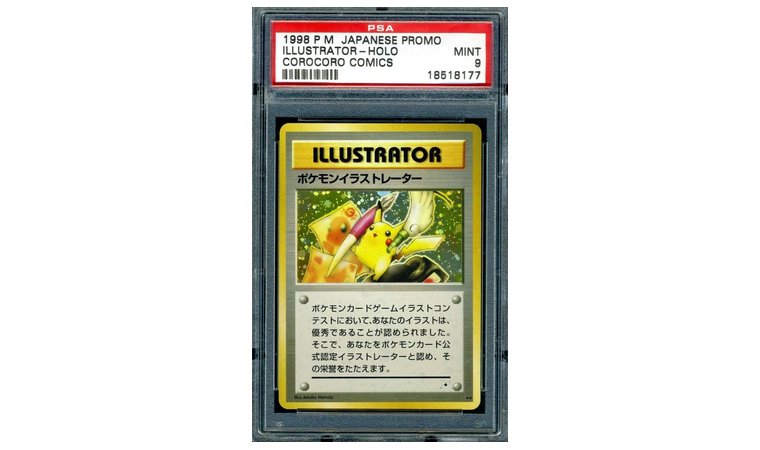
2. Pikachu Illustrator [PSA 9]
- Publication Date: 1998
- Grading: PSA 9
- Market Price: $1,275,000
To probably no one’s surprise, the next most expensive Pokémon TCG card ever is also the Pikachu Illustrator (or Illustrator Pikachu), except graded PSA 9.
I promised you some more history, and here we go. When we say that Logan Paul bought the PSA 10 Pikachu Illustrator for $5,275,000, he didn’t pay it fully. Instead, he paid $4,000,000 cash as well as a PSA 9 Pikachu Illustrator, thus giving this card its highest-ever market value of $1,275,000.
As you might have noticed, this card goes for a lot less than its Gem Mint version, though $1,275,000 is still a very hefty sum. In contrast to a PSA 10, a PSA 9 is rated as Mint, and, from PSA’s website, has “a very slight wax stain on reverse, a minor printing imperfection or slightly off white borders”. The grading also follows precise centering. Long story short, take care of your cards.
Now, let’s get back to the story of this card. There were three waves of contests held by Corocoro – the first in late 1997, the second and third in 1998. The first batch had 3 top entries as well as 20 other winners, each of whom received a Pikachu Illustrator for their efforts for a total of 23 Pikachu Illustrators.
It’s worth noting that the top 3 also received 20 copies of a card with their illustration on it. The next two contests were a little more stingy with handing out the Pikachu Illustrator, with only 8 handed out in each contest. That gives us 23 + 8 + 8 for a grand total of 39 official Pikachu Illustrator cards in the world. Again, there are actually 41 copies, but maybe they just printed too many and two of those were never awarded.
The story doesn’t end there, though.
3. Pikachu Illustrator [PSA 7]
- Publication Date: 1998
- Grading: PSA 7
- Market Price: $900,000
As you may have guessed, even a PSA 7 of this card is still worth quite a bit.
Before we wrap up our discussion of the Pikachu Illustrator, let’s run down what makes a PSA 7, or Near Mint. According to PSA, a PSA 7 trading card is “a card with just slight surface wear visible upon close inspection.” Fraying is permissible, and the card’s art can be off-center. Stains can also only be on the back of the card, and most of the card’s gloss must remain. There’s a looser – though still strict – requirement for card art centering.
Now, for the last words on the Pikachu Illustrator. Apart from the OG art and rarity, this card also has some unique quirks that make it stand out even more. For starters, this is the only card in the game that has the card type “Illustrator” in the top text box, in contrast to the “Trainer” label in the base set (never mind that it’s not playable).
Next, it’s one of the very few initial cards to boast 2 stars in its rarity symbol in the lower right. Yes, the Scarlet & Violet set in 2023 introduced double rares, but for the longest time, the double star club was very exclusive. Lastly, it has a special fountain pen symbol located at the lower right of the text box.
Now, you might be wondering why this card didn’t become more valuable sooner. The answer to that is pretty simple – time and location. When the contests were being held and the card was newly released, it was 1997 and 1998, and Japan had already known about Pokémon since 1996. Nintendo only exported, localized, and popularized Pokémon outside Japan beginning in 1998, so nobody really knew about it until then!
4. Topsun Charizard – Blue Back [PSA 10]
- Publication Date: 1995
- Grading: PSA 10
- Market Price: $493,230
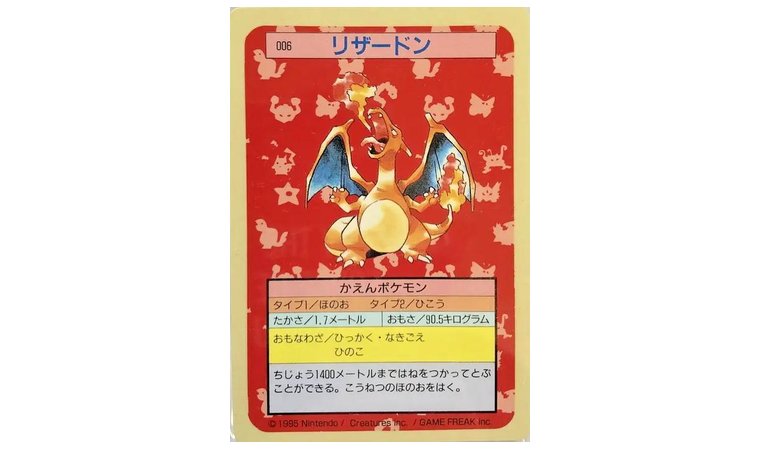
Yeah, I know some of you are sighing, shaking your heads, and thinking, “Well, of COURSE it’s Charizard.” True, but keep in mind that a specimen is not a Pokémon Trading Card, at least not in the way you’d expect.
You might’ve noticed already, but this Charizard doesn’t look anything like the playable trading cards. That’s because it’s a collectible card from the candy company Top Seika, which frequently collaborated with other brands. In this case, they collaborated with Pokémon, releasing collectible cards alongside their gum, and this particular Charizard is part of that early collection, which is one of (if not the) earliest official Pokémon cards – that debate rages on.
The reason why sellers have to denote “blue back” is similar to 1st Edition prints of the Base Set. See, the Topsun set printed quite a lot of cards, but only the first print run had a blue back. Succeeding prints were distinguished by their green back, making the blue back cards much, much rarer and way more valuable.
While there are definitely more Topsun Charizards than Pikachu Illustrators, the fact still stands that this card is a very limited commodity, thanks to being available only in Japan and as part of the first print. What’s even rarer is to find one that’s in gem mint condition, as unlike the Pikachu Illustrator, this card wasn’t a prize but a collectible card that could be traded, discarded, or forgotten!
5. Trophy Pikachu Silver [PSA 10]
- Publication Date: 1997
- Grading: PSA 10
- Market Price: $444,000
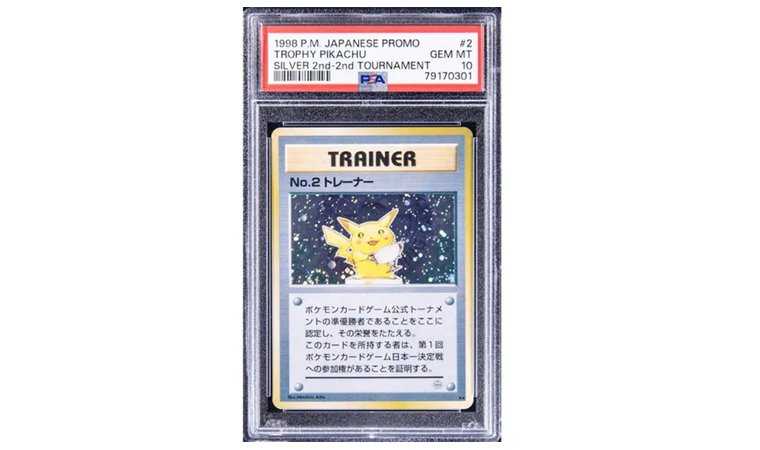
The name of the card might tip you off: the Trophy Pikachu Silver was awarded to second place winners of the first and second-ever Pokémon TCG tournaments. These tournaments, the Japanese Pokémon Card Game Official Tournament in 1997 and the Lizardon (Charizard) Mega Battle tournament in 1998 were Japan-only events.
Art-wise, this card is pretty cute. Illustrated by Mitsuhiro Arita (my favorite artist for old cards), this one depicts a happy Pikachu holding up a silver trophy, set against a silver foil background. It’s worth noting that Arita also did the artwork for the gold and bronze versions of this card, which were awarded to the first and third placers, respectively.
This is yet another Pokémon trading card that does nothing, as Google Translate tells me that the text says, “We hereby recognize and congratulate you for being the runner-up in the official Pokémon Card Game tournament. The holder of this card is certified as having the right to participate in the 1st Pokémon Card Game Japan Championship.”
Just like the Pikachu Illustrator, all of the Trophy Pikachus are very rare cards, with the consensus being that there are just 14 copies of them in existence. What sets this one apart, however, is that it’s PSA 10. Goldin, the company that held the auction, claims that only 4 Trophy Pikachu Silvers have ever been graded, and of those four, this one was the only copy to hit a PSA 10 grade. A silver trophy it may be, but it’s definitely worth gold.
6. Base Set Charizard – 1st Edition Shadowless [PSA 10]
- Publication Date: 1999
- Grading: PSA 10
- Market Price: $420,000
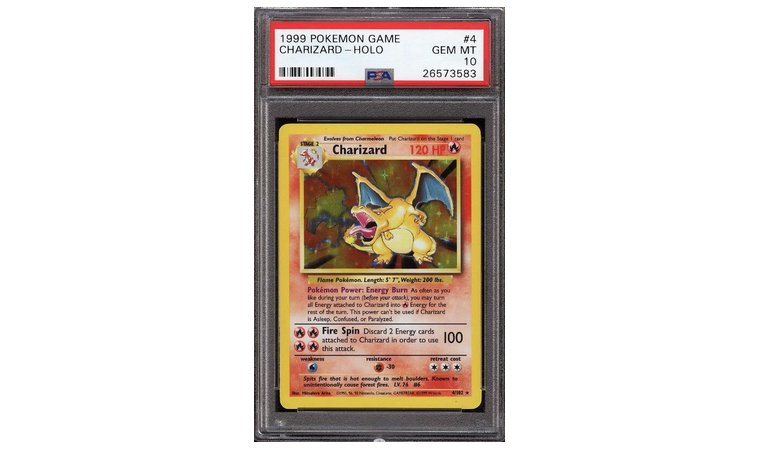
For the longest time, Base Set Charizard was the holy grail of the Pokémon TCG, and even I was surprised to find it had been dethroned. That said, it’s still a really pricey piece of history.
Base Set Charizard is probably the best example of an unga bunga Pokémon I can think of. Gameplay-wise, it’s not particularly good, as it demands that you constantly feed it Energy for almost overkill levels of damage, not to mention that I personally preferred Arcanine. That said, for kids, seeing triple-digit damage on a card was enough of a reason to want to sell everything you had for a single copy of Charizard. That hunger for raw stats never really faded, and it explains why the most expensive Mega Evolution cards remain so popular among high-end collectors today.
Despite its shortcomings, none can deny that Base Set Charizard is a valuable card, and this copy hits all the right marks. PSA 10 (so you know this one went straight from the booster pack to somewhere safe), 1st Edition Shadowless (1st edition cards lack a certain “shadow”; this helps verify their authenticity), as well as a holo finish to top it off, fetched a price tag of $420,000 in a 2022 auction.
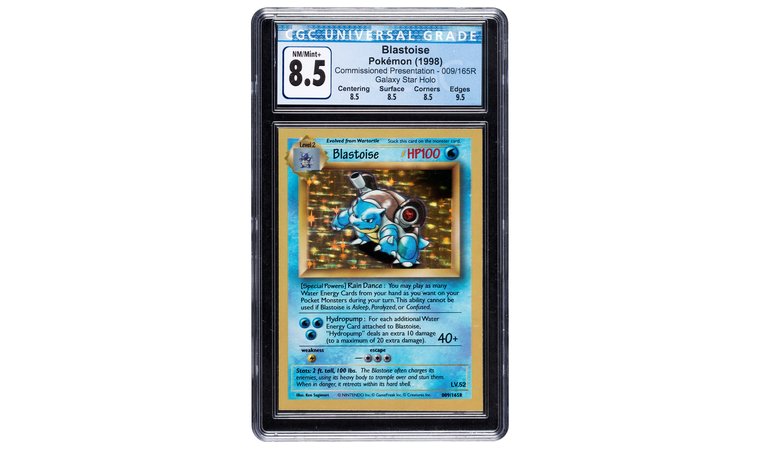
7. Blastoise WOTC Presentation Galaxy Star Holo [CGC 8.5]
- Publication Date: 1998
- Grading: CGC 8.5
- Market Price: $360,000
It’s not just you – the text on this card looks off, and if I didn’t know any better, I might just dismiss this Blastoise as a knockoff. However, it’s the real deal: this one was part of a small print run of just four prototype cards, printed by Wizards of the Coast back in 1998.
Upon closer inspection, this card is almost like the playable Blastoise, sans too much text. Pokémon was always written as “Pocket Monsters,” there was no bold print on the Ability box, there was no Resistance mechanic, there were vital stats in its flavor text, and so on. The back is also worth noting, as it seems that at the time, there was no proper Pokémon card back just yet.
This Blastoise, however, has the distinction of having a white card back, while the other three used Magic: The Gathering backs. CGC rated this card as 8.5, which roughly corresponds to a PSA 8-9; CGC’s decimal system tells us that it’s an 8 in very good condition.
Interestingly, a former WotC employee chimed in about this card. According to them, this card was created so that the media could see what an English Pokémon card would look like. Because of this, it was labeled “Commissioned Presentation”. Thank goodness they refined the final product.
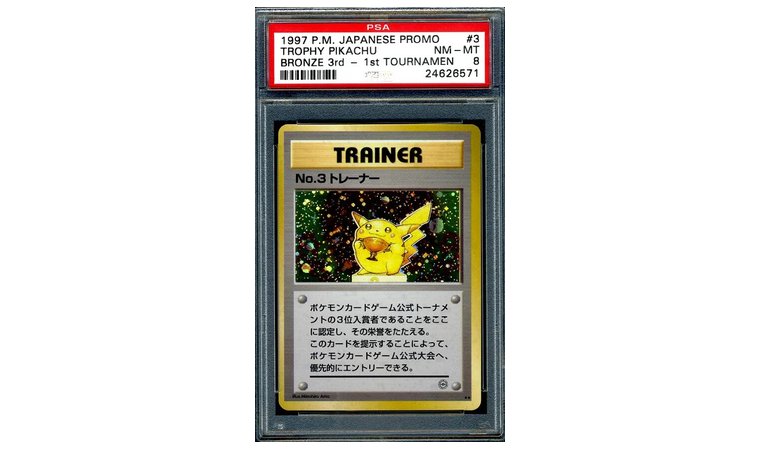
8. Trophy Pikachu Bronze [PSA 8]
- Publication Date: 1997
- Grading: PSA 8
- Market Price: $300,000
As with the silver version, this Pikachu was the 3rd place award in the Japanese Pokémon Card Game Official Tournament of ‘97 and the Lizardon Mega Battle tournament of ‘98.
Like its silver counterpart, this card features an illustration by Mitsuhiro Arita, which depicts Pikachu holding up a bronze trophy against a glowing bronze background. This Pikachu sports a closed mouth, which in a way makes it look quite a bit more pleased with itself than the silver one. And it might just be my eyes, but this Pikachu looks chunkier (and cuter) than its more expensive counterpart!
Unsurprisingly, this card also saw a very limited release. Due to being a trophy card, there are only 14 verified copies of it in existence. Half of those cards have been graded by PSA, and this version was graded Near Mint. Like the silver version, it was also auctioned by Goldin, with an initial price of $25,000 and a final price of $216,000 after 23 bids.
9. Ishihara GX Promo [PSA 7 / PSA 9 with Autograph]
- Publication Date: 2018
- Grading: PSA 7 / PSA 9 (Autograph)
- Market Price: $247,230
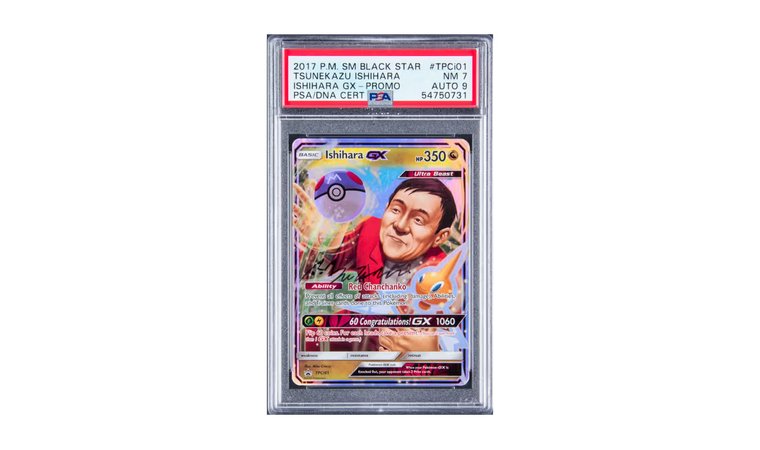
Now for a Pokémon card that isn’t a Pokémon. This card features the president and CEO of The Pokémon Company, Tsunekazu Ishihara, celebrating his 60th birthday. The only requirement for getting one of these was to attend a private event that ran concurrently with the 2018 World Championship in Nashville, Tennessee. There was no production log for this card, so the rough estimate for how many Ishihara GX’s there are range from 30-200.
The Ishihara card features Tsunekazu Ishihara with both a Master Ball and a Rotom, and has a rather hilarious attack that makes you flip 60 coins – good luck getting your opponent to let you resolve that.
Ishihara GX is also classified as an Ultra Beast, so he’s either an amazing boss or an eldritch abomination. I’ll let you decide which. The artwork for this is pretty unique as well; it was designed by Mike Cressy, who does illustrations for “Pokémon” cards of humans. To date, Mr. Cressy has only drawn 2 cards for the TCG.
What bumps up this card’s value even more is the autograph, which is from Ishihara himself. To put things in perspective, you would not only need an invite to this private event, but be lucky enough to get Ishihara to sign your copy!
The autograph was graded separately from the card, with Ishihara’s signature receiving a PSA 9 rating, while the card received a 7. None of this detracted from the card’s value, and a copy was sold via Goldin for a hefty $247,230 in 2021.
10. Kangaskhan Family Event Trophy [PSA 10]
- Publication Date: 1998
- Grading: PSA 10
- Market Price: $175,000
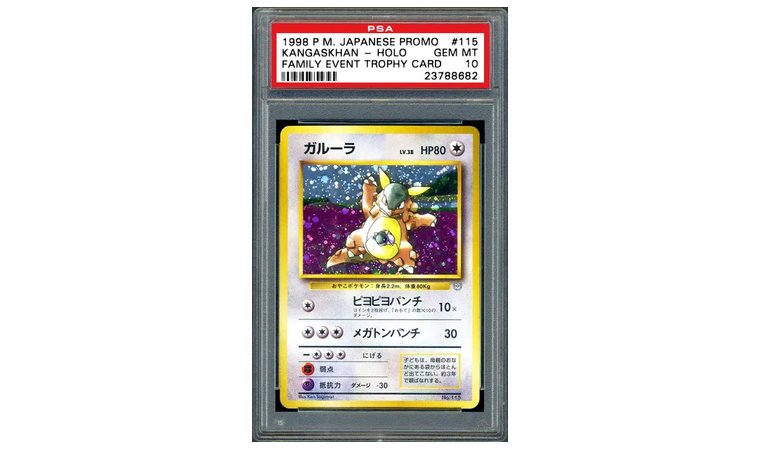
Kangaskhan’s epithet is the parent Pokémon, so it’s rather fitting that this trophy card was only handed out to teams at the 1998 Parent/Child tournament, which ran alongside the Lizardon Mega Battle event.
In this tournament, adults and kids (not necessarily parent-child teams, though I imagine it was highly encouraged) duked it out in a 2v2 tag team format, with the top 8 teams receiving both this card and a special Kangaskhan dorayaki that probably tasted like victory…
…or so the story goes. There isn’t much information about this card available on the net, and hard research done by other people indicates that the Kangaskhan card was not given at this event, but the dorayaki was. Whatever the case, nothing changes the fact that this Kangaskhan is a very rare card, with a ballpark estimate of just 50 copies floating around.
As this card seems not to be among the more popular limited cards, prices for it vary wildly. The highest confirmed price so far is $175,000 for a PSA 10 via Heritage Auctions in 2023. The price will likely increase steeply as more of these cards are found!
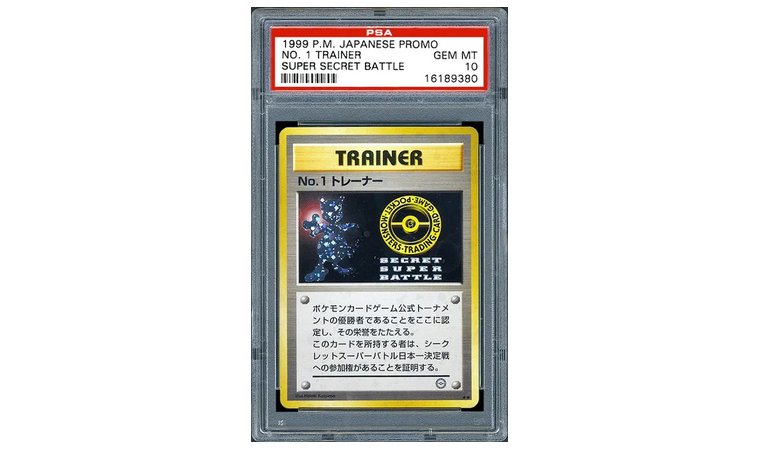
11. No. 1 Trainer – Super Secret Battle [PSA 10]
- Publication Date: 1999
- Grading: PSA 10
- Market Price: $156,000
Back to trophy cards. As with the Trophy Pikachus, the No. 1 Trainer – Super Secret Battle card was handed out as a prize, this time to winners of 1999’s Super Secret Battle tournament, eligible to players from 3rd to 11th grade. I should also mention that this tournament ran alongside another, the Tropical Mega Battle; both contests were part of the Challenge Road ‘99 SUMMER event. As with the other events, this was also held in Japan.
In contrast with the cute Pikachus of earlier trading card game tournaments, this prize card opts for a cooler appeal. The artwork, done by Hideki Kazama, features a Mewtwo silhouette set against a black background with a logo of the event to its right, as well as a holofoil finish.
As for the card text, it reads, “The Pokémon Card Game Official Tournament’s champion is recognized here, and this honor is praised. This proves that the person who possesses this card participated in the Secret Super Battle Best in Japan Deciding Match.” Thanks, Bulbapedia!
Only 7 copies of this card were made, and each of them was awarded to the top placer of each regional tournament. One copy graded PSA 10 was sold via Heritage Auctions in July 2020 and netted its owner a nice sum of $90,000. However, another PSA 10 sale would soon follow in 2022 and go for a higher price of $156,000.
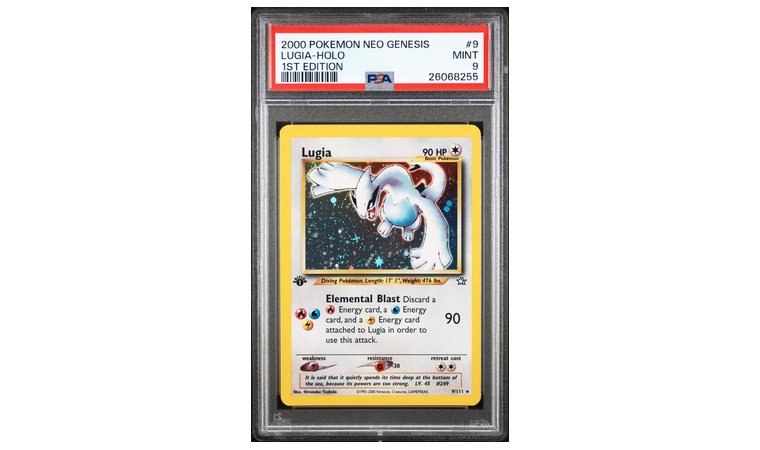
12. Neo Genesis 1st Edition Lugia #9 [BGS 10 Pristine]
- Publication Date: 2000
- Grading: BGS 10 Pristine
- Market Price: $144,300
Vintage cards will always be valuable, especially if they’re from older sets. And if a PSA 10 Gem Mint rating isn’t enough to drive up the price, a BGS 10 Pristine definitely will, as Beckett Grading Services is said to have much more stringent grading requirements.
A report by PWCC Marketplace (now known as Fanatics Collect) in May 2021 reported that only 41 PSA 10 Lugias are in existence, and of those, only 3 made the cut to BGS 10 Pristine. Let that sink in for a moment.
This Lugia is also notable for being the first Pokémon TCG card that required three different non-Colorless Energy to use. Its sole attack, Elemental Blast, costs a Fire, Water, and Lightning each to use – and you have to discard these for a paltry 90 damage. I suppose that you could use Lugia as an early game wall due to its decent HP, but there are better ‘mons for that, like Chansey or Snorlax.
Playability aside, Neo Genesis Lugia does look awesome, and was a fan favorite among Gen 2, so if you pulled this from a booster pack, consider yourself lucky. And yes, Lugia’s design is clearly superior to Ho-Oh’s. I will brook no disagreement on this.
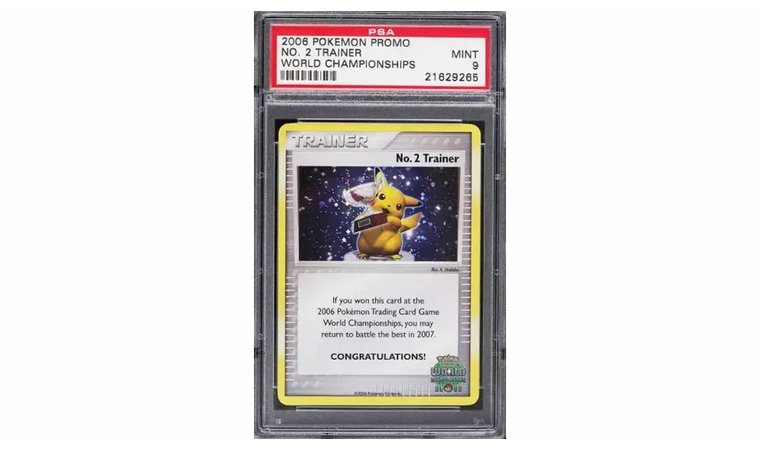
13. 2006 World Championships Trainer No. 2 [PSA 9]
- Publication Date: 1999
- Grading: PSA 9
- Market Price: $110,100
At last, a trophy card that isn’t a Japan exclusive! This particular prize card is printed in English, and it was a reward for hitting 2nd place in the 2006 World Championships, held at the Hilton Anaheim Hotel, California, from August 18 to 20.
I personally prefer the hand-drawn versions by Arita, but alas, this card was made someway into Pokémon’s 3D art era. It does bear some similarities to its predecessors, with a smiling Pikachu holding up a silver trophy, set against a silver background.
Perhaps realizing the value that they were printing into the world, the Pokémon Company decided to print a very small amount of these prizes – the consensus is that there are just 3 of these Pikachus in the world, making this a serious contender for the rarest Pokémon card. This copy was rated PSA 9 Mint, and sold for $110,000 in a February 2021 online auction via PWCC Marketplace. Sadly, the acquisition by Fanatics Collectibles seems to have scrubbed the PWCC webpage detailing the auction events.
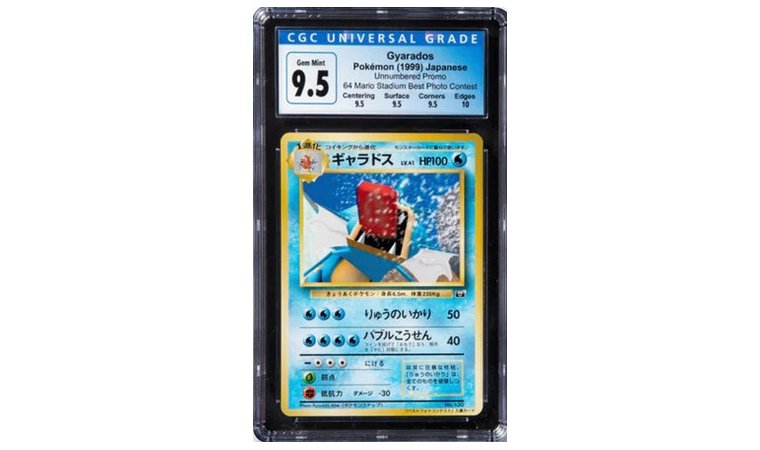
14. Snap Gyarados [CGC 9.5]
- Publication Date: 1999
- Grading: CGC 9.5
- Market Price: $87,500
These days, phone cameras have turned us all into photographers, but back then you’d have to buy film for a camera if you wanted a picture of your favorite Pokémon. That, or do it in Pokémon Snap. Corocoro Comic chose the latter, and in 1999, they held a contest for the best Pokémon Snap photos. This Gyarados was one of 5 winners, and the in-game photo was taken by Ryouichi Abe.
I honestly can’t tell if this card is supposed to be menacing or goofy. It could be a snapshot of the savage sea beast mid-roar…but it could also just be blowing a big fat raspberry, kind of like those goat photos and videos on Instagram. Mind you, this card is perfectly playable as it’s an alt art Base Set card. I hope Ryouichi Abe won many games with it.
Of minor interest is that there were 2 Pokémon Snap contests held. The Corocoro one was first, in 1998. The winning photos here, apart from Snap Gyarados, were Pikachu (yup, this is Snap Pikachu), Bulbasaur, Poliwag, and Magikarp. The winners received 20 copies of their card.
The second contest was the 64 Mario Stadium Best Photo Contest in 1999 (winning photos were Koffing, Charmander, Squirtle, Articuno, and Chansey). Unlike the first contest, the second one only gave out 15 copies of each winning card.
15. Umbreon Gold Star – Japanese PLAY Promotional [BGS 9.5]
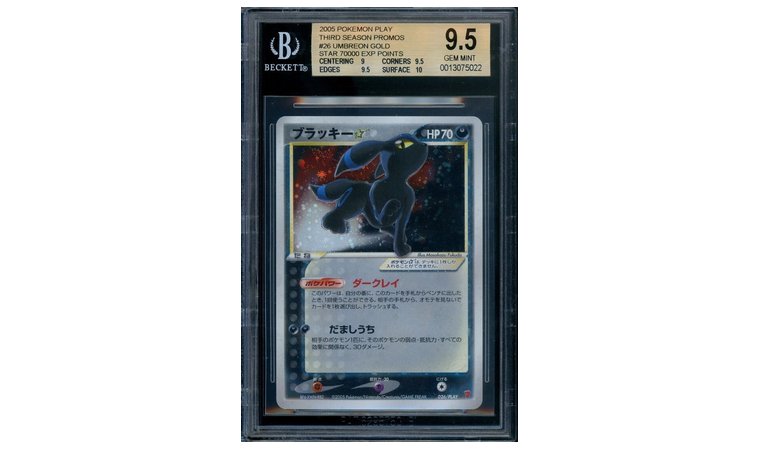
- Publication Date: 2005-2007
- Grading: BGS 9.5
- Market Price: ~$70,000 (2021)
There are a lot of valuable Eeveelution cards out there. Few of them, however, required as much time, effort, and gas money as the Japanese version of Umbreon Gold Star, a promotional card with a lot of story behind it.
While it was released in POP Series 5, this Umbreon could technically be acquired earlier. This was done via the Daisuki Pokémon Fan Club, whose members received points for various activities. In the 2005-2006 season, points could be earned by actions such as attending official or club-hosted events, uploading info to their site, and reaching certain tournament placements, each of which would net you a couple hundred points. Once you had enough points, you’d get a prize. Easy, right?
Umbreon Gold Star required players to reach 70,000 points. No, that’s not a typo.
Keep in mind that there was a very short period of time to obtain Umbreon Gold Star, and point income was very low unless you attended every single event. Little surprise then, that each copy of this card is jealously guarded by whoever owns it – and their prize is marked by a distinct set number that reads 26/PLAY. Don’t be fooled by the 25th anniversary or POP series ones!
If this card was virtually impossible to get, it’s almost impossible to find as there are very few listings for it; the only confirmed sales I’ve found are for a PSA 10 via PWCC for $78,000, and another from a forum (so it may very well be anecdotal) – this time for a BGS 9.5 for roughly $70,000. It’s worth noting that current listings for a BGS 9.5 for this card are sitting at around $200,000.
Most Expensive Pokémon Packs
I maintain that Pokémon is one of the best trading card games to start with, and if you plan to start collecting or playing (sometimes it feels like you need a really good Pokémon card gaming guide), you’ll want to know what sets to pull.
There are a few general factors that influence the cost of a pack, namely circulation status, rarity, and chase cards. Keep in mind that expensive packs aren’t necessarily the best Pokémon sets to pull from – so if you’re looking at this as a player, your money might be better spent elsewhere!
That said, here are the five most expensive Pokémon TCG packs according to TCGPlayer’s listing and market value:
- Evolving Skies – TCGPlayer’s market price for a case, as of writing, is $10,893.77. As for why, well, there are a lot of reasons: lots of chase cards in this set, alt art galore, and lots of high-value singles. Investors agree – this one is a solid investment.
- XY Evolutions – This one sits at a market price of $6,250 per case but is agreed upon to be a very meh set. Scalpers or overproduction, your guess is as good as mine.
- Team Up – This one sits at $574.20 per box. Yes, box. No reprints, good art, and Tag Team GX ‘mons drove up the price quite a bit.
- Plasma Freeze – Market price of $4800 per box. As with Team Up, this one had a lot of valuable cards for both collectors and players, and its age (and no reprints) have only driven its value up.
- 151 – This set has a market price of $4,455.81 for a boost bundle display case. As for the price, it’s probably hype coupled with nostalgia and maybe some FOMO. Regardless, the art is quite gorgeous and a good starting point for both collectors and new players.
Most Expensive Cards in Pokémon 151
I did say that 151 was a good set to start playing or collecting Pokémon trading cards, and if you’re looking to get in on the fun, these cards are a great place to start.
Like the previous list, I used TCGPlayer to get the fair market price for each of these gems:
- Charizard EX Illustration Rare (199/165) – Charizard? Check. Alt art? Check. 1 Energy for potentially 160 damage and a retrained Fire Spin from the classic Charizard? Checkaroo. This one’s got a market price of $19.80, quite a bit higher than the other entries.
- Blastoise EX Illustration Rare (200/165) – Two starters now. Blastoise’s alt art is very nice to look at, and it’s a decent finisher for any Water deck, too. As of writing, the market price of this card is $6.45.
- Venusaur EX Illustration Rare (198/165) – No points if you guessed this one. As I said in my list of the best Pokémon cards, Venusaur EX is a stubborn fat thing that refuses to die and is a worthy addition to any Grass deck. The alt artwork seals the deal, and this burly starter commands a market price of $5.65.
- Zapdos EX Illustration Rare (202/165) – The lord of lightning’s alt art features a striking depiction of it flying in formation with its peers, Articuno and Moltres. If that isn’t enough of a reason to get this card, its ability also lets it retreat for free, and Multishot Lightning is great for sniping your opponent’s bench. The market price is $5.26.
- Charmander Illustration Rare (168/165) – This card’s alt art is possibly a callback to the first Charmander episode in the anime, with the little lizard perched atop a rock formation. This one has an evaluated market price of $4.37, but listings tend to be much lower.
FAQs
Some of the most expensive Trainer cards are Lillie from Ultra Prism (big card draw), Skyla from Boundaries Crossed (who searches any other Trainer card), and Misty’s Favor from Unified Minds (searches up to 3 other Supporters). Bear in mind that all of these are full art cards!
Some of the most expensive PSA-graded Pokémon cards are the PSA 10, 9, and 7 Pikachu Illustrator, the PSA 10 Topsun Blue Back Charizard, and the PSA 10 Trophy Silver Pikachu. Getting a card appraised by the PSA helps establish its real value, so any serious card sale requires grading!
The most expensive base set Pokémon cards are the three starters. TCGPlayer reports prices of $47.04, $16.35, and $12.35 for a holofoil, Near Mint Charizard, Blastoise, and Venusaur, respectively.
The most expensive Charizard card to be sold was (to no one’s surprise) a PSA 10 1st Edition Charizard, with a holofoil finish, which went for $420,000 in 2022. There are also other expensive Charizards, like the Topsun one in the list above, as well as EX prints from more modern sets.
That would be the PSA 10 Pikachu Illustrator, as it was a Japan-exclusive promotional card, thanks to being the prize for a Corocoro Comic contest. It sold for a total value of $5,275,000 – $4,000,000 cash and a PSA 9 Pikachu Illustrator worth $1,275,000.
The most expensive card from the Scarlet and Violet series is Umbreon ex Illustration Rare from Prismatic Evolutions, with a market price of $1,011.07. For collectors, this is probably the best card in the series, though the Prismatic Evolutions set is agreed to be great in general.