

How to Play Pokémon Cards in 2026: A Quick but Thorough Beginner’s Guide

Eneba Hub contains affiliate links, which means we may earn a small commission if you make a purchase through them—at no extra cost to you. Learn more

It’s been a while since the Pokémon TCG was released, and if you’re looking to get in on the fun, you’ll first need to properly learn how to play Pokémon cards. Don’t worry, as this TCG is light, quick, and easy to learn; so simple, in fact, that even kids can pick up how to play in a couple of minutes.
In this beginner’s guide, we’ll go through a step-by-step breakdown of the info you’ll need to understand how to play the Pokémon card game, no matter if your choice is to pick inherited vintage cards or you simply wish to play online with friends.
Jump to:
What Is the Pokémon Trading Card Game?
The Pokémon TCG is a tabletop adaptation of the Pokémon series of video games. In this great trading card game, you’ll duke it out with your opponent to be the first to claim 6 Prize cards, wipe out all of their Pokémon, or drain their deck.
Battles in this game are fast, frantic, and fun, and victory is achieved not just by summoning Pokémon to fight for you, but also by the tactical use of powerful Trainer cards and managing your Energy economy.
If that sounds complicated, I assure you, it isn’t. And while you can learn the game in a couple of minutes, the sheer amount of cards and combinations on offer means that you won’t find this TCG lacking when it comes to strategic depth.
Contents of a Pokémon Deck
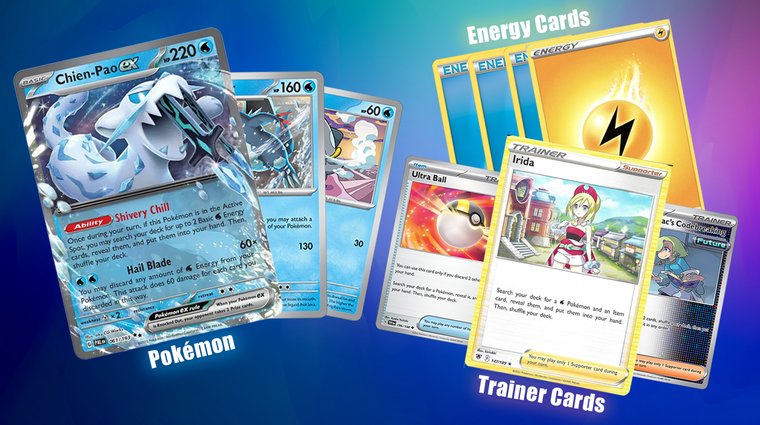
There’s no sense in learning the Pokémon cards rules for beginners if you don’t have a deck to play the game. A carefully constructed deck will give you the best odds of always having access to the cards you need while being able to maintain the offensive or stick to your game plan.
There are some rules when it comes to a Pokémon TCG deck:
- A deck has exactly 60 cards.
- A deck is composed of Pokémon, Energy, and Trainer cards. You must have at least 1 Basic Pokémon in your deck.
- A deck can have up to 4 copies of a card, except for Basic Energy cards.
In a nutshell, cards in your deck have three roles: Pokémon will fight for you, Trainers allow you to do a lot of stuff, and Energy is used to fuel attacks. We won’t dive into the nitty-gritty of each of these, and if you’d like, you can read up on their finer details in a dedicated Pokémon card guide.
Playing Field
Now, let’s take a look at the field. The playing field of the Pokémon TCG is divided into several zones:
- The Active Pokémon spot shows which of your ‘mons is currently in battle. You can only have 1 Pokémon out at once.
- The Bench is located behind your Active spot and houses up to 5 Pokémon in reserve.
- The Deck zone is where you place your deck.
- The Discard Pile is where spent Trainers, discarded cards, and Knocked Out Pokémon go.
- Your Prize cards are found to the left of the board, and this is where your unclaimed Prizes sit.
This setup is standard across matches, so that both players always have a clear view of what’s going on.
How to Set Up the Pokémon Card Game
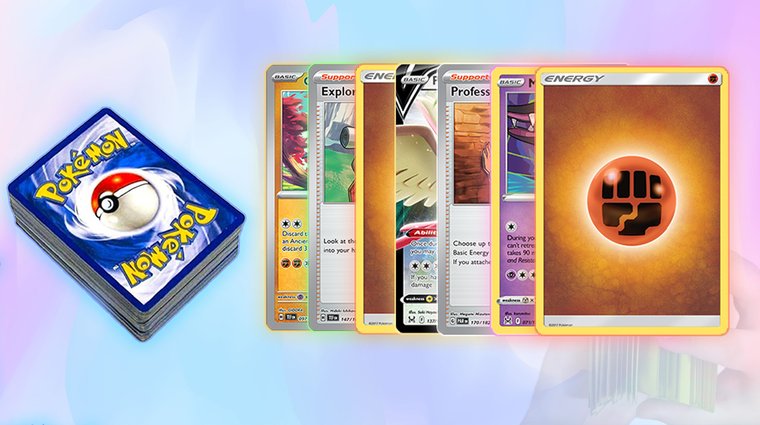
Once you and your opponent have your decks ready, it’s time to set up the game. Here’s how it’s done.
Shuffle Your Deck
Part and parcel of not just the Pokémon TCG rules, but every card game, is to shuffle each player’s deck before the game starts. Proper shuffling means that not only are the cards sufficiently randomized, but that there’s also no cheating involved.
Note that your opponent may opt to cut your deck after you shuffle it, and you can also do likewise.
Decide Who Goes First
It’s important to decide who will go first. No need to go super complex here: choosing who goes first can be decided with a simple coin flip.
Draw 7 Cards
Once you and your opponent have decided the turn order, both of you draw 7 cards from the top of your deck, which will make up your starting hand. Cards in your hand are private knowledge, so make sure your opponent can’t see them.
Play a Basic Pokémon Card to the Active Spot
Next, both players must play a Basic Pokémon in their Active Spot. Bear in mind that you can only play a Basic Pokémon, so no evolutions, VMAX, VSTAR cards, and so on. Remember that a Pokémon card always states its evolution stage.
There are lots of different types of Pokémon cards apart from Basic, so if you’re totally new, reading up on those might be a good idea.
Bench Other Basic Pokémon Cards
Once you have a face-down Basic Pokémon in your active spot, you may also play up to 5 other Basic Pokémon by placing them face-down on your Bench.
Mulligans
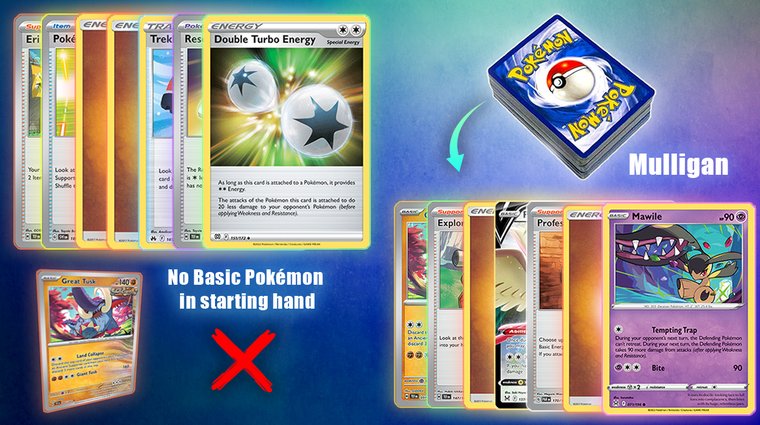
Sometimes, a player doesn’t have any Basic Pokémon in their starting hand. If this happens, they’ll have to take a mulligan.
First, that player must reveal their hand to their opponent, who will verify that there are no Basic Pokémon present. They then shuffle their hand back into the deck and draw a new hand of 7. Hopefully, there’ll be some Basic Pokémon this time.
For each mulligan your opponent takes, you may draw one card.
Set Aside 6 Prize Cards
Finally, both players set their Prize cards. This is done by taking 6 face-down cards from the top of your deck and placing them in the Prize card zone. And no, you’re not supposed to know what your Prize cards are, so no peeking.
Whenever you knock out an opponent’s Pokémon, you can choose one Prize card and put it into your hand. We’ll get more into that later.
Put the Remainder of Your Deck to the Side
The next step is to place the remainder of your deck to the side, far to the right of your Active Spot.
Flip Cards Face-Up and Begin
Once every step has been completed, flip all your face-down Pokémon up before the first player takes their turn. With that, the game is afoot.
How to Play Pokémon Cards
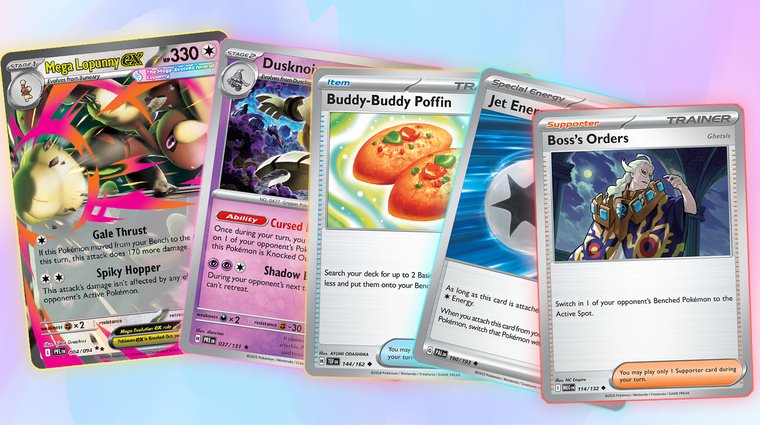
Let’s get to the meat of how to play Pokémon TCG. Don’t worry about complexity; we’ll run through all the moves on a step-by-step basis. Just keep going through the motions, and pretty soon, you’ll find yourself on sites like TCGPlayer, where you’ll be browsing for the best cards and newest strats.
Draw a Card
The first action a player must do on their turn is draw a card from the top of their deck and add it to their hand. This is a mandatory step, and you’ll see why later.
Once you’ve drawn a card, your turn is open-ended, and you can take any (or none) of the following actions.
Play Basic Pokémon on Your Bench
If you didn’t already cram your bench with either your favorites or some of the best Pokémon cards out there, now’s the time. Unless your Bench is at max capacity, you can play as many Basic Pokémon from your hand to the Bench as you like during your turn.
Evolve Your Pokémon
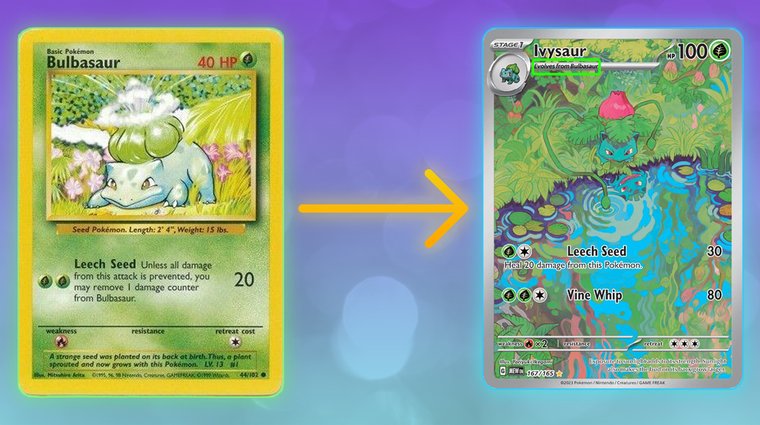
You may also choose to evolve your Pokémon during your turn. This is done by placing an evolution card from your hand over the prior Pokémon (any attached cards and damage counters stick around), and evolution cards always denote what Pokémon they evolve from.
While you can evolve as many times as you like during your turn, keep in mind that you cannot evolve a Pokémon on the same turn it came into play. This means that the first player can’t evolve until their next turn, and that you can’t go from Basic to Stage 2 in one turn either.
Lastly, names are important. It doesn’t matter what Pokémon TCG set a card is from, so long as the names are respected: a Base Set Bulbasaur can evolve into a 151 Ivysaur, since the Ivysaur says “Evolves from Bulbasaur”.
Attach Energy
During your turn, you may attach one Energy card from your hand to any of your Pokémon, no matter if they’re in your Active spot or chilling on the Bench. Pokémon need Energy to fight, so think carefully about which of your ‘mons you’re investing in.
Retreat Your Active Pokémon
You can also choose to recall your Active Pokémon and swap it out with another Pokémon on your Bench. This is done by both checking against any status conditions (more on that later) and discarding Energy attached to that Pokémon, equal to its Retreat Cost.
Play Trainer Cards
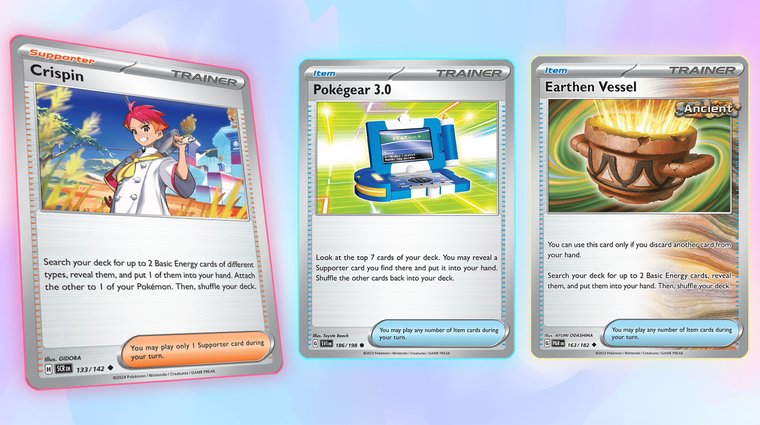
You can also choose to play as many Trainer cards from your hand as you want. Each of these cards provides a variety of effects, from healing your Pokémon to seeking out specific cards. To play a Trainer, just put it into play from your hand and follow the instructions, even if they contradict rules, such as allowing an Asleep Pokémon to retreat.
Two more things to keep in mind. First, while you can play any number of Trainers on your turn, some Trainers are also Supporters, and you can only play 1 Supporter per turn. Second, the player who goes first may not play a Supporter until their next turn.
Use Abilities
Some Pokémon come with Abilities, which can be used freely before you attack. Abilities are always explicitly defined as such, and you can use them even from the Bench and on the first turn.
Attack Your Opponent and End Your Turn
The last action that you can take on your turn is attacking your opponent with your Active Pokémon. This should be the last action you take, as attacking your opponent immediately ends your turn after the attack resolution. If you don’t feel like fighting, you may also choose to pass without attacking.
The player who takes the first turn can’t attack on that turn.
Attacking Your Opponent in Pokémon TCG
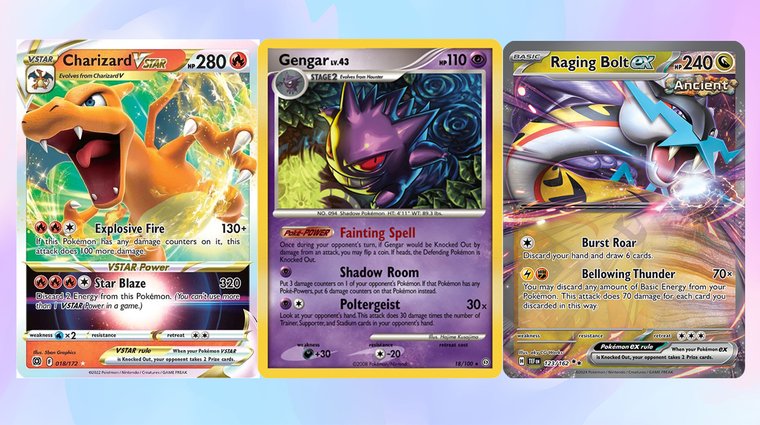
While the mechanics of battle aren’t super complex, they’re deep enough to warrant their own section. Here’s the skinny on how to fight in the Pokémon TCG.
Energy Requirements
Before you declare an attack, your Active Pokémon must be able to pay for the attack. To the left of each attack name is its Energy Cost, which is denoted by symbols. You’ll need to have Energy to match those symbols; for example, an attack that has one Fire symbol requires your active Pokémon to have at least one Fire Energy attached to it.
Some attacks use Colorless Energy, which is denoted by a white star. You can pay for this with any type of Energy. A Charmander that requires a Fire and a Colorless can use that attack with two Fire Energies, a Fire and a Fairy Energy, and so on.
Energy remains attached to a Pokémon when it attacks, unless the attack explicitly states that you must discard Energy to use it.
Damage and Damage Counters
Most attacks deal damage, and the amount of damage an attack does is listed to the right of the attack name. When a Pokémon takes damage, you place damage counters on it to denote how much damage it’s taken, with counters coming in denominations of 10, 50, and 100.
Damage counters don’t go away when a Pokémon evolves.
Weakness and Resistance
As with the video game, the Pokémon TCG has a weakness and resistance system in play, which can be seen in the bottom part of each Pokémon card.
If your opponent’s Pokémon receives an attack from your Pokémon whose type matches the weakness in your opponent’s data, the attack does double damage. Conversely, if you hit your opponent’s creature with a type it resists, it takes 30 less damage. This bonus damage and resistance can make or break a game, so do utilize this system whenever you can.
Remember: it’s the attacking Pokémon’s type you look at for weakness and resistance calculation, not the type of Energy the attack uses.
Knock Out
When a Pokémon has damage counters equal to or more than its HP, it becomes Knocked Out. A Knocked Out Pokémon is sent to the discard pile, along with any cards attached to it (Energy, certain Trainer cards), as well as any prior evolutions it had. The player whose Pokémon was Knocked Out then brings out a new Pokémon from their Bench.
Whenever a player knocks out one of their opponent’s Pokémon, they take one of their Prize cards.
How to Win the Pokémon Card Game
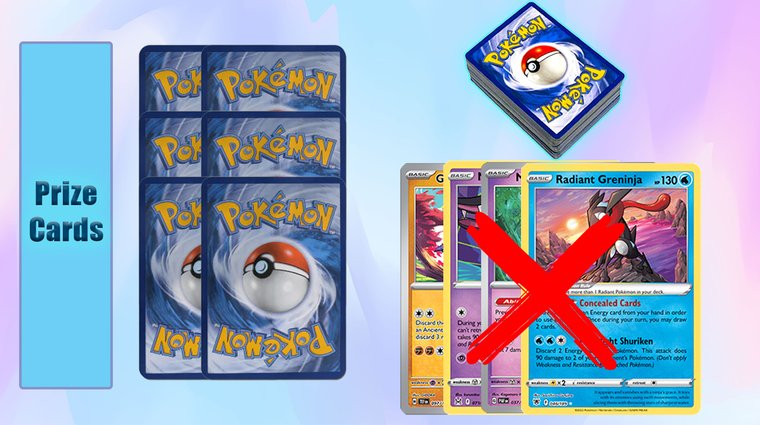
No game is complete without a way to win, and every action you take in a game of Pokémon TCG should ultimately push you towards one of the game’s three win conditions. It doesn’t matter how the board looks when the game ends, so always keep your eyes on the prize.
There are three ways to win a match:
- The first way to win a game is to take all 6 of your Prize cards. As with the Pokémon video games, losing 6 ‘mons (AKA, your entire team) means you lose.
- The second way you win is if your opponent has no Basic Pokémon left to switch to after a Knock Out. They’re out of Pokémon, so they lose by default.
- The last way to win is by deck out. If a player can’t draw a card from the deck at the start of the turn due to having no cards, they lose via deck out.
Games in the Pokémon TCG can go by pretty quickly, so be sure to keep a careful eye on your opponent’s Prize cards or for any moves that can sweep your Bench.
Special Conditions
Part of understanding the Pokémon Trading Card Game rules is knowing what each Special Condition does. These can turn the tide of battle in your favor by forcing bad conditions on your opponent.
The Special Conditions in the game are as follows:
- Asleep. Asleep Pokémon are flipped sideways. A sleeping Pokémon can’t attack or retreat. During the Pokémon Checkup phase (the phase in between turns), you flip a coin: heads means your Pokémon wakes up, tails means it stays asleep.
- Burned. During Pokémon Checkup, a Burned Pokémon takes 20 damage. Their owner then flips a coin; heads removes the burn, tails maintains it.
- Confused. Confused Pokémon are turned upside-down. When attacking with a Confused Pokémon, you flip a coin: heads means the attack goes through normally (including any requirements such as discarding Energy), tails means the attack fails, your Pokémon does 30 damage to itself, and your turn ends.
- Paralyzed. Paralyzed Pokémon are flipped sideways. Paralyzed Pokémon can neither attack nor retreat on their own. Paralysis is always cleared during Pokémon Checkup.
- Poisoned. During Pokémon Checkup, Poisoned Pokémon take 10 damage. Unlike Burned, there’s no removal check for Poisoned.
Keep in mind that some conditions stack. A Pokémon can be Poisoned and Burned simultaneously, but conditions that rotate the card (Asleep, Confused, Paralyzed) don’t stack.
Lastly, retreating or evolving a Pokémon removes all Special Conditions.
Other Mechanics
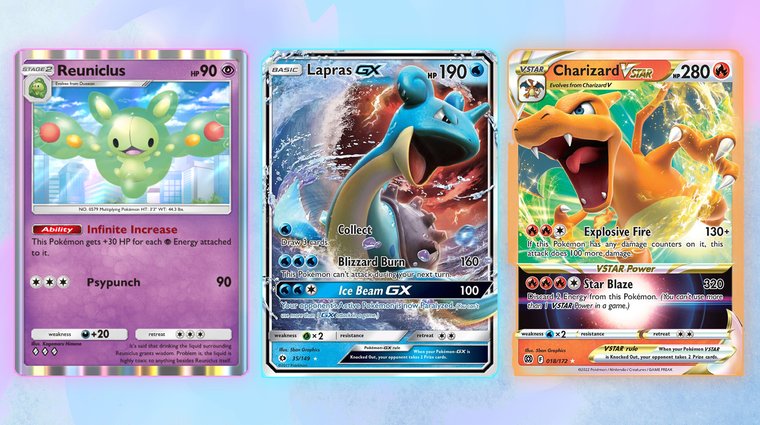
We’re pretty much done with the Pokémon card game rules, but there are a few more mechanics I’d like to touch on.
Healing
Some Pokémon abilities, attacks, or Trainer cards heal. Healing damage is accomplished by removing damage counters from the healing target, meaning you can’t overheal. Healing Special Conditions, on the other hand, just has you put the card upright and/or remove the Poisoned or Burned counter.
Pokémon-ex and -EX
Some Pokémon have ex or EX in their name. This means that they have boosted stats, and in the case of most EX cards, are Basic Pokémon as well.
These Pokémon are much stronger than your standard cards, but there’s a catch: losing them will give your opponent 2 Prize cards instead of the usual 1, so be sure to plan around this.
Lastly, as with many Pokémon with suffixes, ex and EX Pokémon tend to come in high rarities, but let’s save arguments such as holo vs. reverse holo for collectors.
Pokémon-GX
Pokémon-GX are very similar to -ex cards: they have way higher stats, and their attacks hit much harder, though they also give out 2 Prize cards on Knock Out.
The main difference with Pokémon-GX is their unique GX Attack. These attacks are absolute gamechangers, but they’re special in that you can only use one GX Attack in a game, so it’s super important to spend your one shot tactically.
Mega Evolution
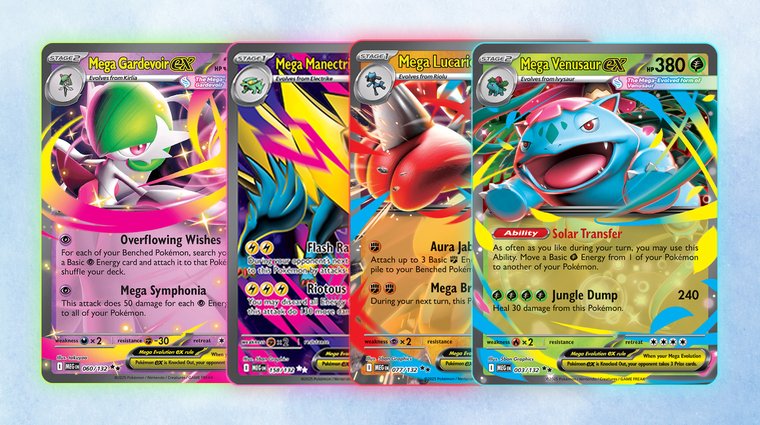
If you thought Ex and GX Pokémon were top strongest Pokémon cards, wait ‘til you see Mega Evolutions. These cards evolve from standard Pokémon (just like regular evolution cards), but the payoff is so worth it, with their vastly boosted stats and game-ending attacks.
Mega Evolutions follow a unique mechanic. It used to be that Mega Evolving ended your turn, but these days, all you need to do is consult the rule box on the card itself, not unlike ex, EX, and GX cards.
BREAK Evolution
While evolution in Pokémon has always traditionally been about going up, BREAK Evolution does it sideways. BREAK Pokémon can be seen as upgrades to fully-evolved Pokémon, and are played sideways over their prior evolution.
BREAK cards are unique in that they augment, rather than replace, their previous stage. This is done by giving them a new attack or a new ability.
VSTAR Powers
GX attacks are powerful, sure, but sometimes, what you want is utility. That’s where VSTAR Pokémon come in, which are special cards that must evolve from Pokémon-V.
As with their other suffixed peers, VSTARs boast inflated stat lines, better attacks, and yield more prizes on Knock Out. However, they also come with a once-per-game ability called a VSTAR Power. These powers often do something crazy, and best of all, unlike GX Attacks, there’s no cost attached to them.
VMAX Pokémon
The V-line of Pokémon cards also contains the giant mechanics seen in Sword & Shield, this time via VMAX. No frills this time: VMAX Pokémon are titans that are hard to take down with their huge HP and devastating attacks.
However, there’s always a catch, and VMAX ‘mons yield 3 Prize cards on defeat. That’s half the Prizes you need to win, so be very mindful when you use these cards.
V-Union Cards
Last in the V-series are V-Union Cards, which are four cards that make up one giant Pokémon. Unlike standard cards, V-Unions are played by first discarding their components, then assembling them on your Bench, once per game. And since they’re made of 4 cards, V-Unions have a lot more moves at their disposal.
At the same time, be careful. While V-Unions are unquestionably powerful, they also yield 3 Prize cards on Knock Out.
Additional Tips for Beginners
Before we go, let me share a few more tips for beginners:
- Since you can only attach 1 Energy card per turn, plan for ways to increase your Energy income. The faster your Pokémon can come online, the better your chances of winning.
- In even the best deck-building games, there are no hard and fast rules for ratios. However, the Pokémon TCG is famous for its incredibly potent Trainer cards. Use these to your advantage whenever you can.
- Playing Basic Pokémon to your Bench isn’t always the optimal strategy. Sometimes, this can give away your intended win condition. For example, it might be smart to keep a Pokémon with an ability in your hand until you intend to use it; this way, your opponent can’t anticipate your next move.
- While more Prize cards taken means you’re closer to winning, be wary of cards that have a catch-up mechanic where the difference in Prize cards can lead to devastating damage.
With all that said, you’re now ready to start your own Pokémon TCG journey. Best of luck, and remember to have fun.
FAQs
The point of Pokémon TCG battles, as with any game, is to have fun. If you like the neck and neck competition of tense combat or just want to play with your favorites, the Pokémon TCG is a great way to pass the time.
Yes, the Pokémon TCG is very easy to learn and play. It’s actually one of the easiest TCGs out there, and I’d heartily recommend it as your first card game if you’ve yet to start.
Pokémon cards can roughly be divided into Pokémon (of which there are many types), Trainers, and Energy. Each of these has a part to play, so be sure to read each of them carefully.
The info you find on a Pokémon card depends on what type of card it is. For Pokémon, you typically find their name, evolution stage, HP, attacks, weakness, resistance, retreat cost, and other rule boxes.
Pokémon-V are a special type of Pokémon that aren’t just stronger than usual (and give out more Prizes when defeated), but also interact with other V-mechanics: VMAX, V-Union, and VSTAR.
A mulligan happens when a player’s starting hand has no Basic Pokémon. They reveal their hand to their opponent, shuffle it back into the deck, then draw a new hand of 7. For each mulligan a player takes, their opponent can choose to draw a card.
Benched Pokémon are Pokémon in reserve. While they’re not actively fighting, Benched Pokémon can still use their abilities and can swap out with the Active Pokémon if it’s in trouble.