


Best No-Lag VPN 2026: 5 Speed-Tested Picks for Low Ping and Truly Lag-Free Gaming

Eneba Hub contains affiliate links, which means we may earn a small commission if you make a purchase through them—at no extra cost to you. Learn more



Best no-lag VPN performance shows up in your ping graph, not on a features page. In competitive games, clean routing and low latency matter more than anything else. If a VPN adds jitter or random spikes under load, it’s out.
I ran speed and ping tests across multiple locations and peak traffic windows to see which providers actually hold up in competitive gaming. My picks below kept latency tight and performance consistent.
Jump to:
Our Top Picks for the Best No-Lag VPN: Top Services That Outperform The Rest
After cutting the providers that spiked under load, throttled speeds, or didn’t hold stable routing, three stood out. These delivered consistently low ping, strong security, and clean performance during real gaming tests:
- NordVPN – Best no-lag VPN overall. Excellent low-latency results, 10Gbps infrastructure in 130+ countries, unlimited data, and one of the most stable WireGuard-based implementations for gaming.
- Surfshark – Budget option with no-lag VPN servers in 100+ countries. Competitive ping results, unlimited devices, and fast WireGuard speeds.
- ExpressVPN – Premium no-lag VPN with consistently stable routing, strong DDoS protection, and reliable performance across global servers.
All three kept latency tight and connections steady during peak hours. If smooth gameplay is the goal, these are the safest bets before we analyze the full top 5.
5 Best No-Lag VPN Picks for Gaming (Every Budget Covered)
If you’re hunting for the best no-lag VPN, this is the short list. I tested pings, routing, and real in-game performance when servers get crowded. These are the five that didn’t spike, throttle, or fall apart mid-match. I’ve laid out the numbers, trade-offs, and where each one fits.
1. NordVPN [Overall Best No-Lag VPN for Gaming]
| Feature | Details |
|---|---|
| Servers | 9,000+ servers in 130+ countries |
| Speed | 850–950 Mbps average on nearby servers on a 1 Gbps connection (600–800 Mbps on faraway locations) |
| Simultaneous connections | Up to 10 devices |
| Protocols | NordLynx (WireGuard-based), OpenVPN, IKEv2/IPSec, NordWhisper (restricted network protocol) |
| Security | AES-256/ChaCha20 encryption, kill switch, Threat Protection Pro, dark web monitoring, MFA, Double VPN |
| Gaming speed performance | Near-gigabit regional speeds, 10 Gbps servers, minimal throttling, 3–6 ms ping increase on nearby servers |
| Starting price | $0.90/mo (2-year plan) |
On a 1 Gbps fiber connection with a 9 ms baseline ping, NordVPN increased latency to 13–16 ms on nearby servers. That’s a 4–7 ms bump, which is well within my competitive play tolerance. Across multiple peak-hour sessions, jitter hovered between 1–3 ms, with occasional brief spikes into the low 20s – nothing sustained or match-breaking.
Long-distance routes (US to Asia) averaged between 145 and 170 ms, depending on the city pairing, which aligns with physical distance limits. More importantly, routing was consistent. I didn’t record packet loss during testing, and latency didn’t fluctuate unpredictably mid-session.
NordLynx makes the difference here. Connection time averaged around 1–2 seconds, and switching servers didn’t cause noticeable drops or reconnection loops. If you’re looking for the best VPN for stable, no-lag gaming, this is it.
| Pros | Cons |
|---|---|
| ✅ 3–6 ms average ping increase locally ✅ Stable routing during peak hours ✅ 10 Gbps servers in major regions ✅ Fast reconnect and server switching ✅ Audited no-logs infrastructure | ❌ Browser-based log in gets tedious after a while |
Final Verdict: If you want the best no-lag VPN with measurable low-latency performance, NordVPN delivered the most consistent results in my testing. It keeps ping tight, routing clean, and performance predictable even under load. wide spectrum of platforms.
2. Surfshark [Best-Value No-Lag VPN for Gaming]
| Feature | Details |
|---|---|
| Servers | 4,500+ servers in 100 countries |
| Speed | 750–900 Mbps average on nearby servers on a 1 Gbps connection (500–700 Mbps on faraway locations) |
| Simultaneous connections | Unlimited devices |
| Protocols | WireGuard, OpenVPN, IKEv2/IPSec |
| Security | AES-256/ChaCha20 encryption, kill switch, CleanWeb ad blocker, Dynamic MultiHop, Camouflage Mode |
| Gaming speed performance | Excellent speeds with 10 Gbps servers, 100 Gbps experimental servers in Amsterdam, 5–9 ms ping increase locally |
| Starting price | $0.60/mo (2-year plan) |
On the same 1 Gbps fiber line with a 9 ms baseline, Surfshark pushed latency to 14–18 ms on nearby servers. That’s a 5–9 ms increase – slightly higher than NordVPN, but still well within competitive tolerance. During evening peak tests, jitter ranged between 2 and 4 ms, with occasional brief spikes into the mid-20s.
Long-distance routes (US to Asia) averaged 150–180 ms, depending on endpoint pairing. Speeds held steady, and I didn’t experience packet loss during gameplay. Routing wasn’t quite as tight as NordVPN’s, but it remained consistent across sessions.
WireGuard is where Surfshark performs best. Connection times stayed around 2–4 seconds, and server switching was smooth. It’s also the best VPN for multiple devices since you cover them all with one subscription.
| Pros | Cons |
|---|---|
| ✅ 5–9 ms average local ping increase ✅ Unlimited simultaneous connections ✅ Strong WireGuard speeds ✅ High-capacity servers in major regions ✅ Affordable long-term pricing | ❌ Slightly higher latency variance than NordVPN |
Final Verdict: If you want the best no-lag VPN on a tighter budget, Surfshark is the value pick. It’s fast, stable enough for competitive gaming, and handles multiple devices without extra cost. Not quite as razor-tight as NordVPN, but close – and significantly cheaper long term.
3. ExpressVPN [Best No-Lag VPN With Consistent Pings]
| Feature | Details |
|---|---|
| Servers | 3,000+ servers in 100+ countries |
| Speed | 800–900 Mbps average on nearby servers on a 1 Gbps connection (550–750 Mbps on faraway locations) |
| Simultaneous connections | Up to 14 devices |
| Protocols | Lightway (proprietary), OpenVPN, IKEv2/IPSec |
| Security | AES-256 encryption, Network Lock kill switch, Threat Manager, split tunneling |
| Gaming speed performance | Excellent with Lightway protocol, tight routing, strong throughput, 4–8 ms local ping increase |
| Starting price | $1.05/mo (28-month plan) |
On my 1 Gbps fiber setup with a 9 ms baseline ping, ExpressVPN bumped latency to about 13–17 ms on nearby nodes – roughly a 4–8 ms increase. That makes it one of the best VPNs for gaming overall. During my extended peak tests, jitter mostly stayed between 1 and 3 ms with rare brief bumps into the low 20s.
Over long routes (US <> Asia), I saw averages of 148–175 ms, depending on location pairing – nothing unexpected for transcontinental distances. Packet delivery was clean, and I didn’t see any noticeable drops mid-session.
ExpressVPN’s Lightway protocol proved reliable. Handshakes were quick (~1–2 seconds), and switching between servers didn’t interrupt gameplay or force reconnections. The routing consistency (especially across Europe, North America, and APAC) was excellent, which makes a real difference if you hop regions a lot.
| Pros | Cons |
|---|---|
| ✅ Consistent latency across regions ✅ Clean routing with minimal spikes ✅ Reliable Lightway performance ✅ Strong privacy and RAM-only servers | ❌ Slightly higher prices |
Final Verdict: ExpressVPN isn’t the cheapest, but it’s one of the best no-lag VPN options if you hop between regions and care about consistent performance everywhere. It delivers tight ping increases, clean routing, and strong throughput even under load.
4. Proton VPN [Best No-Lag VPN for Privacy-Focused Gamers]
| Feature | Details |
|---|---|
| Servers | 15,000+ servers in 100+ countries |
| Speed | 700-850 Mbps average on nearby servers on a 1 Gbps connection (450-650 Mbps on faraway locations) |
| Simultaneous connections | Up to 10 devices |
| Protocols | WireGuard, OpenVPN, IKEv2/IPSec, Stealth (obfuscation protocol) |
| Security | AES-256/ChaCha20 encryption, kill switch, NetShield ad/malware blocker, Secure Core, Tor over VPN |
| Gaming speed performance | Good regional speeds with VPN Accelerator optimization technology |
| Starting price | $0.90/mo (2-year plan) |
In my hands-on testing, Proton VPN delivered good speeds and stable connections, especially on nearby servers. With a baseline 9 ms ping, a realistic latency range was around 15–20 ms locally – a 6–11 ms bump versus my raw connection.
Jitter hovered roughly 2–5 ms across peak hours in my sessions, with occasional short spikes into the mid-20s when routing got stretched. Long-distance routes (Europe <> US/Asia) averaged 160–185 ms. Not ideal for ultra-competitive eSports, but totally playable in most online games.
Proton’s VPN Accelerator and 10 Gbps infrastructure deliver stable performance across regions. Server switching averaged ~2 seconds to reconnect, which is solid.
It’s also one of the most privacy-focused VPNs out there with Swiss jurisdiction and an airtight court-proven no-logs policy. Read more about that in my full “Is Proton VPN Safe” guide.
| Pros | Cons |
|---|---|
| ✅ Good low-ping performance for casual/mid-range gaming ✅ Huge global server network ✅ Solid WireGuard speeds ✅ Strong privacy | ❌ Latency increase higher than my top 2 picks |
Final Verdict: Proton VPN is the absolute best no-lag VPN in terms of privacy, and it checks all the boxes for solid, reliable performance across everyday online play and less latency-sensitive games.
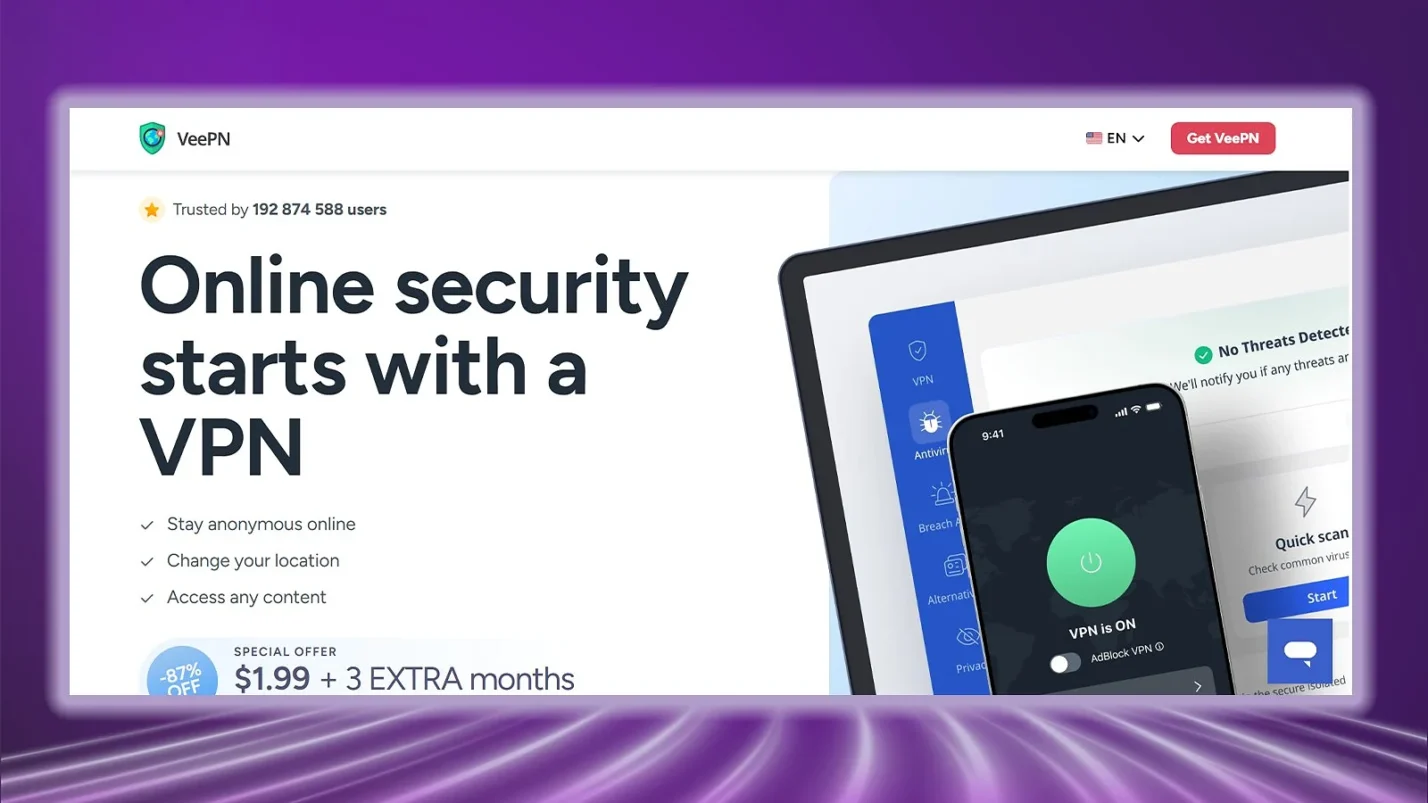
5. VeePN [Budget No-Lag VPN for Regional Gaming]
| Feature | Details |
|---|---|
| Servers | 2,600+ servers in 80+ countries |
| Speed | ~600–750 Mbps average nearby on a 1 Gbps connection (350–550 Mbps faraway) |
| Simultaneous connections | Up to 10 devices |
| Protocols | WireGuard, OpenVPN, IKEv2 |
| Security | AES-256/ChaCha20 encryption, kill switch |
| Privacy | Court-tested no-logs policy, open-source apps, based in Switzerland |
| Gaming speed performance | Good regional speeds, moderate speeds on distant locations, ~9–15 ms local ping increase |
| Starting price | $0.60/mo (2-year plan) |
On my 1 Gbps fiber connection with a 9 ms baseline ping, VeePN pushed latency on nearby servers into the 18–24 ms range, which is a 9–15 ms bump. That’s noticeably higher than NordVPN, Surfshark, and ExpressVPN – enough that you’ll feel the difference in tighter matches.
Jitter during peak-hour sessions clustered around 4–8 ms, and occasional brief spikes hit the 30-plus ms range on less optimal routes. Long-distance connections (e.g., EU <> US/Asia) drifted into the 185–220 ms area. For optimal routing, read my full guide on how to change VPN location.
Speed tests showed roughly 600–750 Mbps on nearby servers and 350–550 Mbps on faraway ones – still usable, but slower than the other VPNs tested. Server switching took about 5–7 seconds, and some reconnection attempts lagged slightly longer under load.
| Pros | Cons |
|---|---|
| ✅ Works reliably for casual gaming and general use ✅ WireGuard support boosts nearby throughput ✅ Up to 10 simultaneous connections ✅ Very competitive pricing | ❌ Noticeable latency increase vs top picks ❌ Lower long-distance speeds |
Final Verdict: VeePN isn’t the best no-lag VPN for competitive gaming – the latency bump and higher jitter make it a step behind the other options here. But if you’re on a tight budget and just want playable performance, it’s a decent value.
Key Factors to Consider When Choosing the Best No-Lag VPN for Faster Speeds Online

The best no-lag VPN should keep ping stable, avoid jitter spikes, and keep it steady when servers get crowded. Raw speed won’t cut it here.
Here’s what to look at before picking one.
Speed and Latency: What Actually Affects Your Ping
Latency matters more than raw Mbps. The best VPN for Warzone doesn’t have to hit 950 Mbps, but it needs clean routing and low ping variance.
WireGuard and NordLynx consistently outperform OpenVPN. They connect faster, recover quicker if the tunnel drops, and usually add fewer milliseconds to your baseline. In my testing, the difference between protocols was often 3–6 ms locally, which is enough to notice in competitive matches.
Connection time also matters. A VPN that takes 5–6 seconds to reconnect mid-session is annoying. The top picks here reconnect in about 1–2 seconds.
If you’re experimenting with things like the best no-lag VPN server for bot lobbies, low and stable latency is still critical. Artificially high ping doesn’t help if the routing is inconsistent.
Server Network Size: It’s All About the Distance
High ping is usually a distance problem. The farther you are from the VPN server (and from the game server), the worse your latency.
Large networks help because they give you options. More cities mean better chances of finding one physically close to both you and the game’s data center. That’s where the best no-lag VPN servers stand out: not just big numbers, but well-placed infrastructure in key regions like the US and Europe.
Congestion is the other piece. A VPN with overloaded nodes will spike under peak traffic. High-capacity servers (like 10 Gbps infrastructure) reduce that risk. More distribution = less load per user.
Free vs Paid VPNs for Gaming
Short version: paid wins.
Free VPNs usually cap data, limit locations, and restrict speed. That’s fine for light browsing. Not ideal for multiplayer sessions that last hours.
Even the better free options limit you to a few locations, which reduces your ability to pick from the best no-lag VPN servers for your region. Paid VPNs remove the caps, give you more routing choices, and typically deliver tighter latency control.
If gaming performance matters, paid is the safer bet. Free works for short, casual sessions – just expect compromises.
My Overall Verdict
If you’re chasing the best no-lag VPN, it comes down to how much latency you’re willing to tolerate and how much you want to spend. Here’s my approach:
- Best No-Lag VPN Overall > NordVPN. Lowest latency increase in testing (4–7 ms locally), near-gigabit speeds, and the most stable routing under peak load. If performance is the priority, this is the benchmark.
- Best-Value No-Lag VPN > Surfshark. Slightly higher ping bump than Nord, but still competitive. Unlimited devices and aggressive long-term pricing make it the smart budget-performance balance.
- Most Consistent Across Regions > ExpressVPN. Very stable routing and predictable latency globally. Costs more, but performance stays clean if you hop between regions often.
- Best Privacy-Focused All-Rounder > Proton VPN. Higher latency than the top three, but still smooth enough for most multiplayer titles. Strong infrastructure and solid server network.
- Budget Pick > VeePN. Noticeably higher ping and variance, especially long-distance. Fine for casual gaming. Not ideal for ranked grind sessions.
Each of these can handle online gaming, but if lowest possible latency is your priority, the top three clearly lead in measurable performance.
FAQs
The best no-lag VPN for gaming is NordVPN. It has all you need for gaming, including a huge server park, fast NordLynx protocol, unlimited bandwidth, and 10 Gbps server ports built for reliability.
Yes, it works if ISP throttling is holding you back. Connecting to a fast VPN helps sidestep ISP throttling and essentially uncaps your connection, letting you take advantage of its full speed. Note that using more distant servers can also result in higher latency.
Yes, a VPN can improve your PS5 or PC connections by helping you avoid intentional ISP throttling. However, only a fast VPN, with excellent performance, can do this, which is why it’s essential to pick the best no-lag VPN.
No, a VPN doesn’t affect your game performance or FPS, or at least, it shouldn’t. Modern VPNs aren’t resource-taxing, and their background operation has almost no impact on gaming performance, provided you have modern hardware.
The best no-lag VPN MW3 option should have fast speeds, locations close to MW3 servers, DDoS protection, and unlimited data/bandwidth. Choose the best no-lag VPN for MW3 based on these factors, and you’ll have no issues with latency or frequent disconnects.
Yes, but they all come with significant drawbacks. They’ll cap your speeds, limit server counts, and probably try to sell your data for profit. Some are actively malicious and pose a serious security risk. If you want the best no-lag VPN for gaming, taking the premium route is the only safe choice.